I travel quite a lot, and up until now I have been lucky. Bags have been lost from time to time, but they have always made their way back to me, usually within 24 hours. I understand that bags can get lost occasionally, but the frustrating thing last time this happened was the complete absence of any reliable information.
I flew from Edinburgh to London Heathrow, then onwards to Washington Dulles where I was incorrectly instructed to enter the USA through the transit lounge. Since my flight to New York's La Guardia was on a separate reservation and my bag had only been checked through to Washington this put me in the wrong place to reclaim it, and trriggered what I would call a comedy of errors if there was anything the least bit funny about it. My bag and I were both in Dulles, but United were unable to reunite us. I was initially assured that the bag would join me on the flight to La Guardia but, inevitably, I arrived and it didn't.
So I registered a claim and went to my accommodation. It took forty-eight hours and ten 'phone calls before I was finally able to wear the clothes I had brought with me. For most of that time United's web site was telling me that the bag had been found and that it would be sent to New York on a non-existent flight shortly before I landed at Washington!
Talking to other travellers, the general impression is that baggage "help" lines are uniformly bad. My own experience was certainly terrible: I could easily have believe that there was no computer-based information system at all behind the scenes, as the different people I spoke to gave me completely different and inconsistent stories each time I called. The responses almost seemed calculated to inflame. I was particularly incensed by a conversation with one woman who, when I called back as requested after waiting two hours, insisted that I had only called thirty minutes previously, and that I should wait until next morning before calling again. It's not usually considered good customer service to call the customer a liar. The different stories I was told about my luggage might as well have been chosen at random.
Under these circumstances the airlines would do better to dispense with the call centres completely and replace them with a recording saying "Our staff are working to restore your lost bag. Thank you for your patience". This would be less irritating than the nonsense I had to put up with, would have taken up far less of my time, and would hopefully reduce costs and allow the airlines to invest a bit more in relocating and delivering lost bags.
And now, if you'll excuse me, I have to send a claim for reimbursement to United.

"Any sufficiently advanced technology is indistinguishable from magic" -- Arthur C Clarke
Musings from the technological frontier
December 12, 2006


December 1, 2006
Blogger on a Nokia 770
Well, I find myself with only a Nokia 770 Internet tablet to access the 'Net, so I thought I'd see how easy it was to create a blog entry. The typing is less than terrific through the hunt-and-peck on-screen keyboard, but so far I haven't been able to get my snazzy laser-projection VKB virtual keyboard to work reliably with the Nokia, so I have to be satisfied with the standard mechanism..
One rather strange feature of the interface seen through the Nokia is the invisibility of the title field. I see in the postings list that I've somehow managed to call it JU, but I really can't see how to change it. Maybe I'll change it later.
I seem to remember that the AJAX functionality used to work, but that's not the case since I upgraded the operating system. Maybe there's some setting that I need to update, but if so it eludes me. Anyway, this has taken quite long enough so I'll save the post as a draft and put the title right before I post it.
Browser Statistics (Hello, Robots)
During the current statistics trawl I started to wonder which browser technologies dominated among the visitors to the Holden Web site. November was an interesting month because both Microsoft and the Mozilla team released new products.
Here is typical information for the top ten client programs. Unlike previous statistics, Firefox users account for almost a half of the traffic to the site - usually Internet Explorer leads the pack with about 30%, but in November it was relegated to third position.
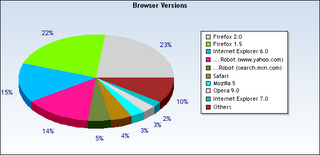
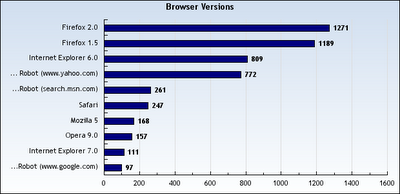
Internet Explorer 7.0 currently accounts for 2% of traffic, the first time it's appeared in the stats. The thing I found most surprising was the fact that more Firefox users were using the recently-released 2.0 version than anything else. 2% of users still use Firefox 1.0.
Rather less delightful is the fact that 20% of site traffic is spidering (though how come Yahoo has to crawl so much more aggressively than anybody else is beyond me). Perhaps the real message is that I need to put some more compelling content on the site!
Here is typical information for the top ten client programs. Unlike previous statistics, Firefox users account for almost a half of the traffic to the site - usually Internet Explorer leads the pack with about 30%, but in November it was relegated to third position.


Internet Explorer 7.0 currently accounts for 2% of traffic, the first time it's appeared in the stats. The thing I found most surprising was the fact that more Firefox users were using the recently-released 2.0 version than anything else. 2% of users still use Firefox 1.0.
Rather less delightful is the fact that 20% of site traffic is spidering (though how come Yahoo has to crawl so much more aggressively than anybody else is beyond me). Perhaps the real message is that I need to put some more compelling content on the site!
A Tip o' the Hat to Ron Stephens
Looking at my web site statistics the other day I discovered, as you might expect, that the majority of referrals were coming from Google. However the notable second source is Ron Stephens' Awaretek site. Ron has been quietly generating Python reference materials and producing a Python podcast for years now, with vary little in the way of public acknowledgement. So thanks, Ron, keep up the good work!
Database API Tutorial at PyCon TX 2007
The list of PyCon tutorial offerings has now been finalised, and I'm happy to say that my Database API proposal has been accepted. Once again there is a great line-up of tutorials. It must have been hard for the program committee to choose this year's line-up since most of the offerings were strong and from well-respected speakers.
This doesn't guarantee that any tutorial will run: there have to be enough sign-ups for that to happen. This year there is also a tutorial on SQLAlchemy, and it looks as though the schedule will allow people wnating to understand how to use databases in Python to go through the DB API in the morning and then learn SQL Alchemy in the afternoon. I'll be conferring with Jonathan Ellis to make sure that I cover any necessary background for those who want to attend both.
I'm hoping that my tutorial will be well-received — last year's filled the room, and helped me fund my attendance at PyCon. It's always good to have guidance from students in advance telling me what their "hot-button" items are. If you're thinking of attending you can use this page to provide guidance on the content you'd like to see.
November 24, 2006
A False Sense of Security?
Although I am primarily a technical person I have broader interests than just that, including business and marketing. Sometimes these interests intersect in areas that affect a broader cross-section of the population. This is not a technical post.
One of my sources of occasional reading is Seth Godin, author of several books including All Marketers are Liars. He also runs a personal blog, and in the wake of the Thanksgiving rush he wrote this TSA-inspired post about the stupidity of the air transport security rules and the insensitive way in which they are administered. This really rang bells with me.
Godin courageously risks being thought a whiner by ridiculing the rules that allow a full three-ounce container of gel through the screening but disallow a five-ounce container with only one ounce in it. I've spent a lot of time in US airport security lines, and people aren't generally welcoming of critical remarks. Unfortunately many of the "security" activities that we have to go through are what Bruce Schneier calls security theatre.
At the same time as the TSA are forcing even the airline staff to submit to security screenings there are airports where construction staff are allowed airside simply by swiping an identification card. So the terrorists will be targeting the construction workers, not trying to smuggle six ounces of gel through the passenger channels.
Now I know I'm not the only person to suggest that the US government's initial response to the events of 9/11 was off-target. Benjamin Franklin was spot on in saying "Those who sacrifice freedom for security deserve neither". It seems that the majority of American citizens appear to believe that the government has duty to protect them from all risk from the cradle to the grave.
Said citizens, of course, are oblivious to the fact that it is impossible to eliminate risk completely: the aim of security is to raise the cost of a breach to a level that makes the breach uneconomic. But enough is enough. Dulles International has got to the stage where "going through security" can add over an hour to the passenger processing time, and I'm sure others are as bad if not worse. If things go on the way they are, people will stop flying because of the security measures.
What percentage of the American population use the air transport system? How much is being spent every day on airport security theatre, and how many lives is it saving? How much should we be prepared to spend to save a single life? How quickly could we have fresh drinking water available for all of humanity if we spent the money towards that goal instead? How many lives would that save? Which expenditure would make the USA more secure? Isn't it perhaps time for a reassessment of priorities?
November 20, 2006
Movie Moguls Need Control
In yet another example of movie mogul insanity the MPAA, in the guise of Paramount Pictures, is suing a small business that is ripping DVDs to iPods for customers who buy both at the same time. This highlights exactly why the Digital Millenium Copywrong Act was a bad idea, and it shows American politics up exactly at its worst: as a way for wealthy influence groups to get their own way at the expense of the buying public who have made them rich.
Don't even get me started on software patents.
Corporate governance always makes such a huge fuss about how corporations are really responsible to their stockholders. Who are the stockholders of the MPAA members, and why aren't they telling their managements to start respecting the customers who earn them their living?
November 19, 2006
Thunderbird QA Not Slipping!
Well, for my sins I have become a Thunderbird 3.0a1 user, and I can't say I'm happy. Several times the program has threatened to update itself, and eventually the promised (threatened?) upgrade arrived. [NOTE: apparently the 3-series builds are intended only for developers].
The error that originally caused me to update to the latest version is even worse in 3.0a1. Message contents are now being mangled on a regular basis. I have no idea whether they can be recovered correctly or not, and I am beginniing to lose confidence in what has until now been a reasonably reliable piece of software. It's ironic that I am suffering this problem even worse than I was because I wanted to help the project by making an accurate bug report.
If many other users are suffering the same problems I am then this issue needs to be addressed before it starts to give open source a bad name.
November 8, 2006
Thunderbird: Can't Help for Hurting
I've been an enthusiastic Thunderbird user for a fairly long time, and have only noticed odd quirks from time to time. One such quirk is the fact that occasionally a newsgroup article will show completely the wrong content: like the content of some other article altogether. This happened again today, and my first thought was to report the bug.
Now I've reported bugs in the past, and been told that they were duplicates of existing reports. So this time I decided I'd do the right thing and follow the reporting protocol. After all the guys who put Thunderbird together deserve some consideration, and I'm sure many users are cluelessly inconsiderate of the fact they are one amongst milliions and that they haven't paid a cent for some pretty high-quality software. I can't tell whether there is any description of such a bug in Bugzilla -- it might be bug 239665 or it might not.
It turns out that one if the things you are supposed to do is install the latest nightly download in a blank folder with a new profile and see if the same error occurs. This is not a prospect I relish as it will involve a certain amount of setup, but I do the download (nothing much else to do in my hotel room) and start the install. Unfortunately it turns out there's an error in the install, and I see a dialog box showing
One step forward, at least only one step back.
Now I've reported bugs in the past, and been told that they were duplicates of existing reports. So this time I decided I'd do the right thing and follow the reporting protocol. After all the guys who put Thunderbird together deserve some consideration, and I'm sure many users are cluelessly inconsiderate of the fact they are one amongst milliions and that they haven't paid a cent for some pretty high-quality software. I can't tell whether there is any description of such a bug in Bugzilla -- it might be bug 239665 or it might not.
It turns out that one if the things you are supposed to do is install the latest nightly download in a blank folder with a new profile and see if the same error occurs. This is not a prospect I relish as it will involve a certain amount of setup, but I do the download (nothing much else to do in my hotel room) and start the install. Unfortunately it turns out there's an error in the install, and I see a dialog box showing
Microsoft Visual C++ Runtime Library error R6034: An application has made an attempt to load the C rutime library incorrectly. Please contact the application's support teamfor more information.Lucky me: I thought I had one problem, but now I have two. I feel duty bound to report this new error under the "Installer" category. Fortunately the installer completes, and I can run the new Thunderbird to confirm the same error occurs (though I stupidlu omit to bring my RSS feeds forward into my new version). So now I can go ahead and add to the bug report for the original problem, since unfortunately it hasn't gone away. My motivation is severely diminished, however, so this may not actually happen. At least I reported the installer problem.
One step forward, at least only one step back.
November 3, 2006
Stackless Python Continues to Amaze
I recently started tracking the Stackless Python mailing list. I've been interested in Stackless, the brainchild of the fearsomely clever Christian Tismer, for some time now. I recently acquired a client with active interests in that area, so it behooves me to stay up to date.
Stackless allows you to organise your work into tasklets (which as far as I understand it have replaced the original microthreads as the unit for scheduling: this is all pretty new to me, so apologies if it's incorrect). An interesting thing about tasklets is that you can pickle them, pass the pickle to another computer, unpickle them and resume the tasklet in the new environment.
My attention was grabbed by one recent thread in which a user explains that he was trying to perform such interactions across a heterogeneous environment with Power PC, SPARC and Intel-based CPUs and found that it worked between SPARC and PPC, but the Intel architecture appeared to be failing -- presumably due to the different endianness.
After a couple of messages surmising that this was hardly surprising, Christian came into the thread to explain that there was no architecture-dependent code in the pickled thread resumption functionality. Lo and behold, the original poster came back explaining:
With Stackless, your CPUs don't even need to have the same architecture, but the feature will work just as well in the homogeneous environment that multi-processor computers provide.
Stackless allows you to organise your work into tasklets (which as far as I understand it have replaced the original microthreads as the unit for scheduling: this is all pretty new to me, so apologies if it's incorrect). An interesting thing about tasklets is that you can pickle them, pass the pickle to another computer, unpickle them and resume the tasklet in the new environment.
My attention was grabbed by one recent thread in which a user explains that he was trying to perform such interactions across a heterogeneous environment with Power PC, SPARC and Intel-based CPUs and found that it worked between SPARC and PPC, but the Intel architecture appeared to be failing -- presumably due to the different endianness.
After a couple of messages surmising that this was hardly surprising, Christian came into the thread to explain that there was no architecture-dependent code in the pickled thread resumption functionality. Lo and behold, the original poster came back explaining:
I must apologize, it turns out my problem was due to the fact that I was using a different version of stackless on the intel machine. In case anyone is curious, resuming pickled tasklets across architectures is easy. Thank you for your replies!Let me repeat that, just in case you missed it: resuming pickled tasklets across architectures is easy. As far as I can see this gives Python an amazing capability to produce applications with highly-distributed architectures. It's going to be interesting to see where Stackless goes with this, but it should be shouted from the rooftops. This is an advanced feature that represents a real advantage for (Stackless) Python in a world where everyone is wondering how they can accommodate the new multicore processors.
With Stackless, your CPUs don't even need to have the same architecture, but the feature will work just as well in the homogeneous environment that multi-processor computers provide.
October 24, 2006
What, Me, Unique?
Hardly, as the box below shows. But ..
... just the same none of those others have
Oh well, that's enough cheerful for today.
| HowManyOfMe.com | ||
|

- Fathered my son (hi, Simon!)
- Chaired three PyCons
- Written a book about Python
- Taught almost 3,500 students about networking and security topics
- Helped comp.lang.python readers to use Python
Oh well, that's enough cheerful for today.
September 30, 2006
Thunderbird Politically Incorrect?
Someone just posted a rude but amusing remark about a regular comp.lang.python contributor, so I replied off-list with a snigger. Imagine my surprise when Thunderbird's spilling chucker failed to recognise the word and suggested a change to "nigger"!
Nice to be back on the blog. I've been working my ass off lately.
Nice to be back on the blog. I've been working my ass off lately.
July 3, 2006
Moin Moin - Introduction for Developers (Thomas Waldmann, Alexander Schremmer)
MoinMoin was initially a one-man project, but the original author is less frequently available now and there is a core team that is collectively responsible for the code. The project has a large user base, which grew significantly when Unicode processing was introduced and enabled internationalisation.
For the rest of this presentation you should see the published slides, which unfortunately not only accurately represent the content of the talk but also encapsulate its presentation. I suspect (though I do not know them) that the speakers were perhaps nervous, and not therefore confident enough to talk ad lib in a foreign language to what must sometimes seem like an intimidating audience.
I found this a little frustrating since the few departures from reading the slides that the presenters allowed themselves made it clear that they both had an excellent grasp of a very popular Python web application. With more time at the conference I know I would have liked to talk to them both about possible applications and developments.
Literate Testing with Doctest (Marius Gedminas)
Marius started out by outlining the reasonable uses of doctest, both inline in programs and in files that are separate from the source code, and advised us not, for example, to put complicated setup or tests for obscure corner cases in the README. DocTest can be easily integrated with unittest, by defining a test suite that runs the doctests!
He then pointed out DocTestSuite and DocFileSuite for externalising the tests, and considered how to handle complicated setup. One way is to define setup and teardown functions, and you can also put code in test.globs, but these methods should be limited for ease of comprehension.
The advantage of doctest is in encouraging simlicity and interspersed narrative to explain the tests. Another option is to define a test module. The advice is to avoid mixing long tests and regular code in the same file.
In real life, of course, some features of doctest are difficult to use when data is not reliably repeatable (such as the addresses of objects in repr()-style representations). Also problematic are ellipsis-elided outputs, which are to be ignored, and ordering issues. Web testing is even more difficult, as responses are frequently state-dependent. marcus showed some examples of testbrowser, a simple system allowing web testing.
Doctest disadvantages include the disability to step through tests. Documentation (docstrings, README files) should be separated from unit and functional tests.
Questioning revealed that Zope uses a slightly different version of doctest from the Python 2.4 distribution, although "in theory" they offer the same functionality. Jim Fulton asked whether the speaker had looked at Fit (and apprently PyFit is available) but although Jim would like to see Fit and doctest integrated there was no experience with the packages in the room.
The only slightly problematic aspect of this presentation was a couple of times when the speaker made inaudible responses to inaudible questions from the chair. This would have been less troublesome if I had not been at the back of the room, or if the PA system had allowed audibility. Otherwise I got a lot of information in a very short time, well presented.
Working Together on the Web (Kevin Dangoor)
My whole EuroPython experience was a little disjointed, starting with arrival. I and one other delegate ended up on a bus that went, not to CERN but to a local railway station three or four kilometers away. The result was a late arrival, so by the time I took my place in this session Kevin was just starting to present his first example, how to adapt a simple application to the WSGI interface.
Using simple_app was the easiest, but Kevin also showed us how to do it by defining our own class. He then considered the problem of maintaining session state (though Kevin says he prefers not to use state).
WSGI is also helpful in such situations: its concept of middleware (which talks to the web server on one side and a web application on the other) can help. The example here was of a "Latinator" that translated into pig Latin. Kevin showed us how to define a class with a method that can be passed to the WSGI framework as the start_response argument. WSGI is good because there have been many contributions to the PyPI index.
Kevin next introduced us the the Paste system designed by Ian Bicking. This contains a confusing number of packages and modules, which makes it hard to describe and hard to climb the learning curve and start using it. He suggested this demonstrated that even in the Open Source world we are faced with the "build vs. buy" choice, even though "buy" is really an investment in learning someone else's package and build, as usual, is learning and understanding the base technologies you want to implement, and writing your own implementation.
In TurboGears Kevin made the choice to use as much existing technology as was practicable.
The fictitious web package author might decide to package up other dependencies, but this can cause problems for people with other versions of the components she chooses to bundle. This is the classic version dependency. The setuptools system has defined a cross-platform format for installation of Python packages, the .egg format. This can also be used to install packages with binary components, and is proving to be very usable.
The .egg format allows other systems to read the metadata about the package, which is useful in many environments where plugins are used, even in non-Python environments such as Eclipse. The discussion about how entry points were defined to plugins didn't seem terribly easy to understand to me - maybe I was just distracted by the extraneous materials, but I didn't really see the point.
Kevin closed by talking about Beaker, starting by showing us theat it depended on the MyghtyUtils package and defined two paste entry points. The examples at this stage started to leave me wishing I had attended the AJAX session instead, but this could just be me: others might have found the material relevant to their interests.
This presentation relied for contrast on rather too much use of "humourous" slides: a picture of an egg when talking about eggs, a picture of an RJ45 plug in a socket when talking about plugins. I have no objection to such devices, but they should either enhance understanding or be shown for a very short time to give everyone a quick smile before moving on.
Kevin knows his stuff and is always an engaging speaker. A tour de force, though, should really be allocated an hour, and I suspect this session should have covered more ground in less detail or vice versa.
June 19, 2006
Front Page News
Did you ever hear the one about the man who was too busy to save time? I think we all at some stages in our lives lose sight of what we are struggling to do, when perhaps a few quiet moments of contemplation would allow us to move forward.
For a while now I've wanted to finish the www.holdenweb.com front page news feature so I could get on to newer AJAX-based work. The solution, of course, was staring me in the face when I looked for it: instead of holding up AJAX to finish off a pre-AJAX project I could actually use AJAX to speed up its completion. This strategy has worked well.
The original news feed was based on a programmed search of O'Reilly's Meerkat stream aggregator, but Meerkat went away and anyway the mechanism was cumbersome and error prone. I was looking for something lightweight that the mythical "average web user" would be able to use in a fairly foolproof way. I am happy to say that the first prototype is working exceptionally well, and the holdenweb.com front page can now be as up to date as I am!
At the moment the holdenweb.org site is still being generated the old-fashioned way, but I predict the retrofit to this parallel site will be easy.
June 15, 2006
Sitting with Nellie
When I started work "sitting with Nellie" (which meant watching an experienced member of staff do a job, and eventually graduating through helping to doing it oneself) was a time-honoured way of learning to perform a task. Back in mediaeval times it could take five years or more to learn a trade by apprecticeship, but you were a fully trained master when you were finished. Apprenticeships fell out of fashion when companies wanted their staff to be more versatile (and hence more interchangeable), and their death was hastened by the rise of "the training industry" in the 1960s, (with an interest in the training revenues that formal training and its inevitable out-sourcing brought with it).
Apprenticeships may no longer be appropriate, but it's also undeniable that sitting with Nellie had certain advantages over formal training. From a personal standpoint the major advantage was the ability to soak up what I might grandly call the prevailing culture and ethos - to learn how the place worked by talking to people who had been around much longer. I well remember having some of my more naiive assumptions and suppositions being questioned hard by cynics whose cynicism was borne of experience (and sometimes occasioning much good-humoured amusement).
Interestingly, Jon Udell has recently observed that the open source world could use similar techniques to educate people about what was involved in developing software, and specifically the techniques and tools used by the open source world. This approach to an extent generalises (because the open source world is very diverse and so the tools of one project may not be appropriate for another), but the idea has a lot of merit. Ted Leung has further observed that children really don't have any effective way of finding out what they'd like to do, and that a "sitting with Nellie" approach could be helpful in this respect too. This rings true with my own experience. Google's Summer of Code project allows open source projects to offer some experience to students for a liimted period, but there's a lot more we could do.
Le plus ça change, le plus c'est la même chose, as they say in France. We need to realise that change isn't always a good thing and, even if a change once were good, it needn't necessarily be permanent. Perhaps when apprenticeships were discarded an important baby was thrown out with the bathwater of restrictive work practices. Let's see if we can't arrange to have would-be programmers spending some time sitting with Nellie.
May 27, 2006
Need for Speed Wrap-Up
Wow! This week has flown by so quickly there's been no chance to blog about what's been going on in Reykjavik. For those of you who aren't aware of the sprint I have already outlined the basics in Do We Need Speed? but there's more to say. Much more.
Thanks for the Memories
This has been a very busy week, and it's not yet been possible to thank everyone for the roles they have played in putting it together. First of all I must thank all the participants for their efforts. Everyone has worked amazingly hard this week. The declared hours of the sprint (along the lines of extreme programming) were 9:00 am to 6:00 pm, but it wasn't unusual to see people busily working away after 11:00 pm.
I have so enjoyed working with this awesome group, and the teamwork has been great. See the participants list to find out who they are, and see pictures on flickr and on jafo's journal (permanent links on the summary page). Favourite picture of the week has to be from the Blue Lagoon (that's me, with my hand out of the water at the back).
Other web references include these blog entries from Richard Jones and occasional remarks from the effbot, as well as Sean Reifchneider's blog. Jack Diederich has also mentioned the sprint in both his general and his geek blogs.
It's been a pleasure, and I am sure that as the result of working together this week we will all be more open to future collaborations. I sincerely hope that we can find other sponsors to support this work as generously as EWT have.
Thanks for the Support
The Python community as a whole has been awesomely behind us in this effort. Particular mention should go to Neal Norwitz, Andrew Kuchling, Marc-Andre Lemburg and Brett Cannon. They have all helped to flesh out ideas, picked up code nits before they became troublesome and cleared up typos in both code and documentation. Not to mention holding us up by pointing out unfortunate misconceptions which would have led to errors if not squashed. Many others have also pitched in, showing the true Python community spirit by reviewing patches and offering advice, and the sprint's success is theirs as well.
We should not forget the magnificent hospitality of CCP Games, a recently-elected sponsor member of the Python Software Foundation. Not only have they entertained us magnificently all week, they have also had three of their staff at the sprint and have provided local knowledge that has made everyone's week more enjoyable. It's never easy being thousands of miles away from home, and this all helped enormously. Special thanks to Kristján V. Jónsson for giving up so much of his time in a week that included a public holiday.
Thanks for the Sponsorship
We should thank EWT, LLC for the most practical support of all. They have funded the air fares and hotel expenses for fourteen sprint members as well as providing the trip to the Blue Lagoon, coffee throughout the week (sprints run on caffiene) and a close-out dinner at the hotel. They have also sent three of their staff from their Beverly Hills head offices to take part in the sprint, even though that meant they missed their Memorial Day weekend. The fourth-floor sprint room is an extremely refreshing contrast with most places I have sprinted before: access to daylight is quite a novelty (though 24-hour daylight took a little getting used to).
EWT's CEO, David Salomon, addressed the sprint in a teleconference on Wednesday, and explained something about his company's ethos and general approach. EWT's support of the sprint, and more generally of Python, is motivated by business considerations, but David's talk made it evident that he sees EWT's role in a larger context. He also announced EWT's intention to make a donation to the Python Software Foundation and to institute a scholar-in-residence program targeted at supporting individuals making open source contributions.
We also each received a Nokia 770 as a gift from EWT. This amazing little device runs Debian Linux, and Richard Jones had his device running pygame by Wednesday morning.
This is also a good place to record my personal thanks to David for hiring Holden Web to undertake the organization of this event. When I made my first hesitant posting to the conferences-discuss list and ended up as chairman of PyCon DC 2003 I little realised where it would lead.
So, What Have We Achieved?
The formal record of our successes is on this wiki page (and a link is best simply because even as I write this entry there are hackers all around me striving to get even more speed into Python, so we are by no means finished yet). Sean Reifschneider reviewed the outstanding patches and came up with a list of potential speedups, which we have been reviewing and chipping away at as a part of our fairly comprehensive task list. The next release of Python isn't due out until August, so there is plenty of chance to build on the work that's been done.
Although not directly speed-related, we have also put quite a lot of work in on the pybench module, as a result of which its accuracy and repeatability should be improved. Not only that but this work may also lead to the introduction of another benchmark with even better repeatability. Lots of tests have been written this week ...
Until all the new tests are incorporated into formal benchmarks it might not be easy to detect the speedup; it's evident to everyone here, though, that many of the speedups are in areas that the average user will perceive. The improvements to string and unicode handling will probably be welcome to most users. I hope readers will feel free to post comments to let the other sprinters know how much their efforts are appreciated.
And Next?
It is the earnest of hope all the sprinters that this event will demonstrate to the software and related industries that they can engage sections of the open source community in a way that assists both sides. Sprinters have been quite willing to address specific performance issues raised by the sponsors, although there was no compulsion on them to do so, and there has been a general appreciation that both sides will benefit from the sprint.
We live in strange times, and the computing industry is having to come to terms with an infrastructure that is increasingly developed and maintained by people not under their direct control. This is scary to the average commercial manager: David Salomon deserves credit for his perception that those who engage the open source community most whole-heartedly will benefit most.
I fly out of Keflavik at 7:20 tomorrow morning. By coincidence I shall be on the same aeroplane as four American friends who change flights in Iceland. So, I have a week's holiday to look forward to, including visits to Loch Ness and a Guiness brewery. Rest and relaxation will be the order of the day. After that it's back to work, and being a director of the Python Software Foundation.
This has been one terrific week, though tiring, and has built a cohesion among the team which will remain even after the sprint. I hope it leads other organizations to consider supporting the open source community instead of just being passive consumers of the output without putting much back. With luck, much may hinge on this little project.
Thanks for the Memories
This has been a very busy week, and it's not yet been possible to thank everyone for the roles they have played in putting it together. First of all I must thank all the participants for their efforts. Everyone has worked amazingly hard this week. The declared hours of the sprint (along the lines of extreme programming) were 9:00 am to 6:00 pm, but it wasn't unusual to see people busily working away after 11:00 pm.
I have so enjoyed working with this awesome group, and the teamwork has been great. See the participants list to find out who they are, and see pictures on flickr and on jafo's journal (permanent links on the summary page). Favourite picture of the week has to be from the Blue Lagoon (that's me, with my hand out of the water at the back).
Other web references include these blog entries from Richard Jones and occasional remarks from the effbot, as well as Sean Reifchneider's blog. Jack Diederich has also mentioned the sprint in both his general and his geek blogs.
It's been a pleasure, and I am sure that as the result of working together this week we will all be more open to future collaborations. I sincerely hope that we can find other sponsors to support this work as generously as EWT have.
Thanks for the Support
The Python community as a whole has been awesomely behind us in this effort. Particular mention should go to Neal Norwitz, Andrew Kuchling, Marc-Andre Lemburg and Brett Cannon. They have all helped to flesh out ideas, picked up code nits before they became troublesome and cleared up typos in both code and documentation. Not to mention holding us up by pointing out unfortunate misconceptions which would have led to errors if not squashed. Many others have also pitched in, showing the true Python community spirit by reviewing patches and offering advice, and the sprint's success is theirs as well.
We should not forget the magnificent hospitality of CCP Games, a recently-elected sponsor member of the Python Software Foundation. Not only have they entertained us magnificently all week, they have also had three of their staff at the sprint and have provided local knowledge that has made everyone's week more enjoyable. It's never easy being thousands of miles away from home, and this all helped enormously. Special thanks to Kristján V. Jónsson for giving up so much of his time in a week that included a public holiday.
Thanks for the Sponsorship
We should thank EWT, LLC for the most practical support of all. They have funded the air fares and hotel expenses for fourteen sprint members as well as providing the trip to the Blue Lagoon, coffee throughout the week (sprints run on caffiene) and a close-out dinner at the hotel. They have also sent three of their staff from their Beverly Hills head offices to take part in the sprint, even though that meant they missed their Memorial Day weekend. The fourth-floor sprint room is an extremely refreshing contrast with most places I have sprinted before: access to daylight is quite a novelty (though 24-hour daylight took a little getting used to).
EWT's CEO, David Salomon, addressed the sprint in a teleconference on Wednesday, and explained something about his company's ethos and general approach. EWT's support of the sprint, and more generally of Python, is motivated by business considerations, but David's talk made it evident that he sees EWT's role in a larger context. He also announced EWT's intention to make a donation to the Python Software Foundation and to institute a scholar-in-residence program targeted at supporting individuals making open source contributions.
We also each received a Nokia 770 as a gift from EWT. This amazing little device runs Debian Linux, and Richard Jones had his device running pygame by Wednesday morning.

This is also a good place to record my personal thanks to David for hiring Holden Web to undertake the organization of this event. When I made my first hesitant posting to the conferences-discuss list and ended up as chairman of PyCon DC 2003 I little realised where it would lead.
So, What Have We Achieved?
The formal record of our successes is on this wiki page (and a link is best simply because even as I write this entry there are hackers all around me striving to get even more speed into Python, so we are by no means finished yet). Sean Reifschneider reviewed the outstanding patches and came up with a list of potential speedups, which we have been reviewing and chipping away at as a part of our fairly comprehensive task list. The next release of Python isn't due out until August, so there is plenty of chance to build on the work that's been done.
Although not directly speed-related, we have also put quite a lot of work in on the pybench module, as a result of which its accuracy and repeatability should be improved. Not only that but this work may also lead to the introduction of another benchmark with even better repeatability. Lots of tests have been written this week ...
Until all the new tests are incorporated into formal benchmarks it might not be easy to detect the speedup; it's evident to everyone here, though, that many of the speedups are in areas that the average user will perceive. The improvements to string and unicode handling will probably be welcome to most users. I hope readers will feel free to post comments to let the other sprinters know how much their efforts are appreciated.
And Next?
It is the earnest of hope all the sprinters that this event will demonstrate to the software and related industries that they can engage sections of the open source community in a way that assists both sides. Sprinters have been quite willing to address specific performance issues raised by the sponsors, although there was no compulsion on them to do so, and there has been a general appreciation that both sides will benefit from the sprint.
We live in strange times, and the computing industry is having to come to terms with an infrastructure that is increasingly developed and maintained by people not under their direct control. This is scary to the average commercial manager: David Salomon deserves credit for his perception that those who engage the open source community most whole-heartedly will benefit most.
I fly out of Keflavik at 7:20 tomorrow morning. By coincidence I shall be on the same aeroplane as four American friends who change flights in Iceland. So, I have a week's holiday to look forward to, including visits to Loch Ness and a Guiness brewery. Rest and relaxation will be the order of the day. After that it's back to work, and being a director of the Python Software Foundation.
This has been one terrific week, though tiring, and has built a cohesion among the team which will remain even after the sprint. I hope it leads other organizations to consider supporting the open source community instead of just being passive consumers of the output without putting much back. With luck, much may hinge on this little project.
May 21, 2006
Let the Games Begin
I was looking for an erudite Latin tag, but couldn't find one. The Need for Speed sprint starts tonight with a welcome get-together at CCP, the Icelandic company reponsible for the Eve Online game.
I've been monitoring the flight arrivals from my hotel room in Reykjavik, and as I write the flights of the first five arrivals have all been reported as having landed on time. So if all has gone well, and thanks to the assistance of our Icelandic hosts, they should find a driver waiting for them when they clear customs and immigration, getting them to the hotel in around a half an hour.
This is exciting!
April 28, 2006
Tutorials from PyCon
When I finally made time to visit comp.lang.python for the first time in two or three weeks I found a post that said
So of course I had to make sure that the material was available on the web. As a result you con now download my tutorials in either PDF or Open Office Impress format (yes, for once I eschewed using the obvious Microsoft products, and found that the Open Office component was a more-than-acceptable clone).I would like to know if anybody can point me to the site, where it is possible to find the tutorial "Using Databases in Python" which is mentioned by Steve Holden here: http://tinyurl.com/ectj8
Using Databases in Python: Impress PDF
An Introduction to wxPython: Impress PDF
These materials are available under a Creative Commons license. Thank Guido van Rossum for inspiring me with the liberal terms of the Python license.
Subscribe to:
Posts (Atom)